Part 11 of 25
Word problems
Every lesson already ends with word problems, and they do a particular job: they check that the method just taught has sunk in. They also give the method away, by sitting underneath it. A child who has just read about factor pairs knows the next question is about factor pairs.
This section is the other thing. Nothing announces itself. The problems mix topics inside a grade, and the hardest of them do not yield to a procedure at all — they yield to noticing something. Working out what kind of problem you are looking at is the part a lesson can never ask for.
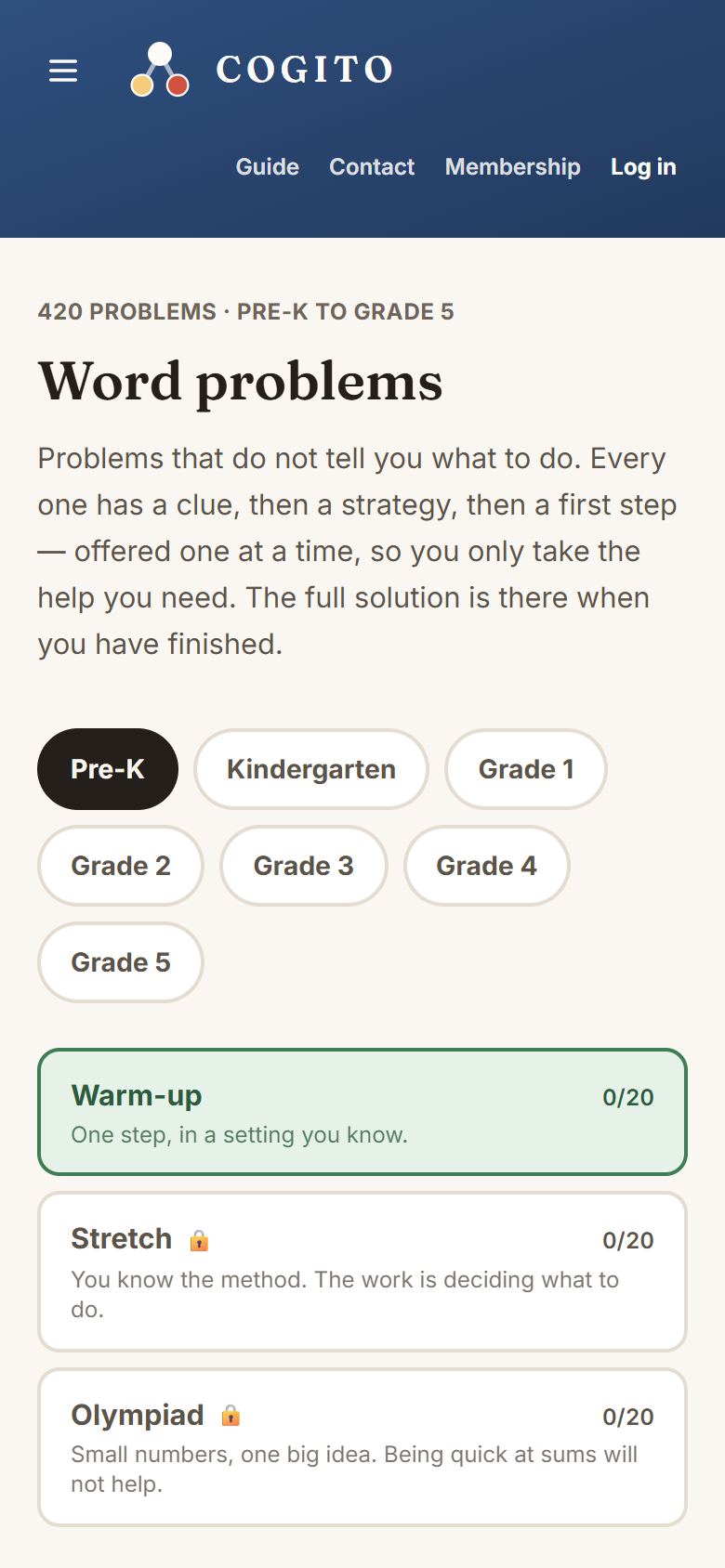
The three tiers

- Warm-up — one step, in a setting your child knows. The arithmetic is the task.
- Stretch — the method is one they have met, but they have to find it. Deciding what to do is the work, not doing it.
- Olympiad — competition-shaped. Small numbers, one idea that unlocks the whole thing, and no advantage at all to being quick at sums.
Twenty problems in each tier, for each grade from Pre-K to Grade 5 — 420 in all. Nothing is locked behind anything else: a child can open any tier in any order.
The help, one rung at a time
Every problem has the same ladder, and it never hands over the answer. A clue says what is worth noticing. A strategy names the move. A set-up does the first step and leaves the rest. Only after a correct answer does the full solution appear.
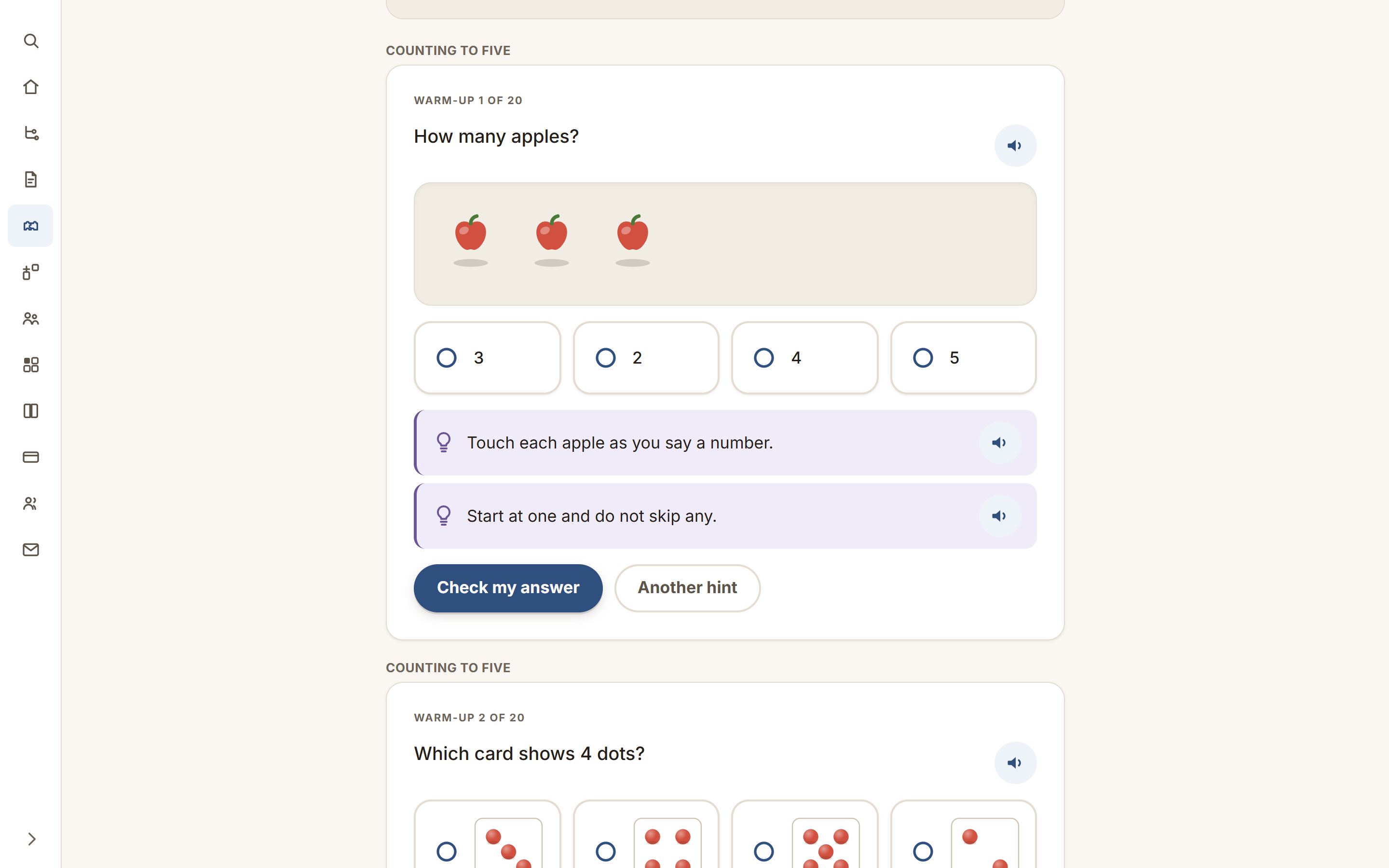
- Your child taps Need a hint? when they want one. Nothing appears unasked.
- After two tries that do not work, the button offers itself — a child who is stuck should not also have to work out that help exists.
- A wrong answer can always be tried again. Nothing is scored and nothing is lost.
Answers are chosen, not typed
Every problem offers three or four answers to pick from. Below Grade 3 that is the only workable way — a tablet keyboard covers the picture a child is counting. Above it, it is still the better one: the wrong answers are not padding. Each is what a particular wrong method actually produces, so the one your child reaches for says something about what went wrong.
Many of the younger problems answer with pictures rather than words — which ten frame holds six, which strip continues the pattern — so a child who cannot read a word problem yet can still meet a real one.
Printing a set
Each tier prints as its own sheet: the twenty problems with room to work, then the answers and full worked solutions on a page of their own, so nobody is reading the answers over the questions.
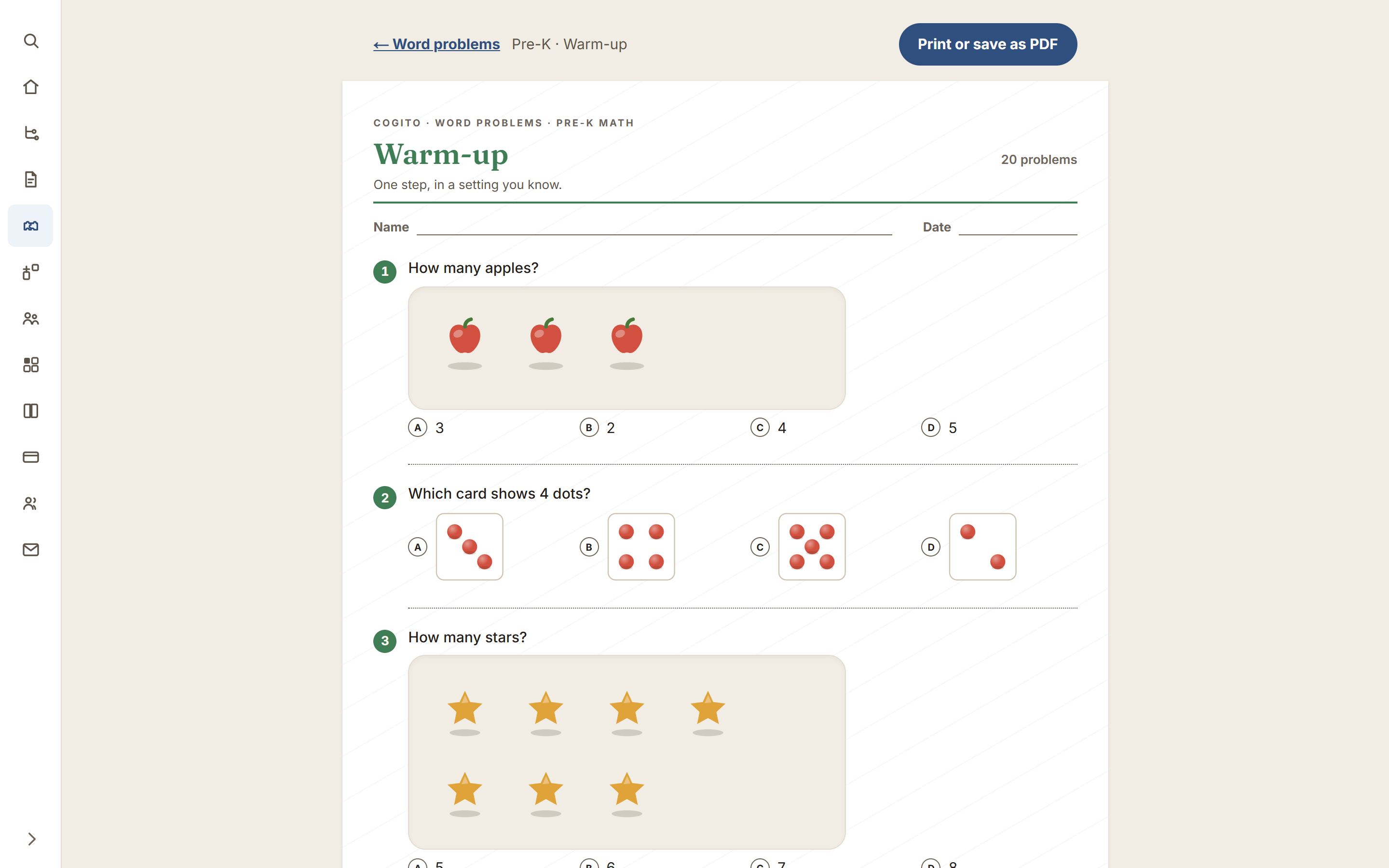
- Choose the grade and the tier, then tap Print this set (PDF).
- Press Print or save as PDF at the top of the sheet.
- In the print box that opens, choose your printer — or choose Save as PDF to keep the file instead.
What is free
The whole Warm-up tier is free, at every grade — twenty real problems per grade, with the hints and the solutions and the printable sheet. Stretch and Olympiad are part of membership. See Free week and membership.
Where the problems come from
They are written for Cogito. The ideas behind the olympiad tier are the common currency of competition math — a folded strip, a handshake count, a remainder that survives every divisor — and ideas belong to nobody. The wording of a Kangaroo or AMC paper does belong to somebody, so none of it is here.