Part 1 of 25
Getting started
Cogito teaches math, reading and science, from pre-school up to the last year of high school. A lesson is not a video and not a page to read. It is something your child touches and changes, and the answer changes with it.
You can try it before anything else
You do not have to sign up, pay, or fill anything in to see whether Cogito suits your child. Two things are open to everybody:
- The first chapter of every course. Every subject, every grade. Open one and read the whole thing.
- The lessons on the front page. Scroll down the home page and you can play with real lessons straight away, without leaving the page.
When you want everything opened up, signing in gives you seven days free. No card is asked for, and nothing is charged when the week ends.
Your first five minutes
Here is the shortest path from arriving to watching your child do a lesson.
- Open cogitolearning.com.
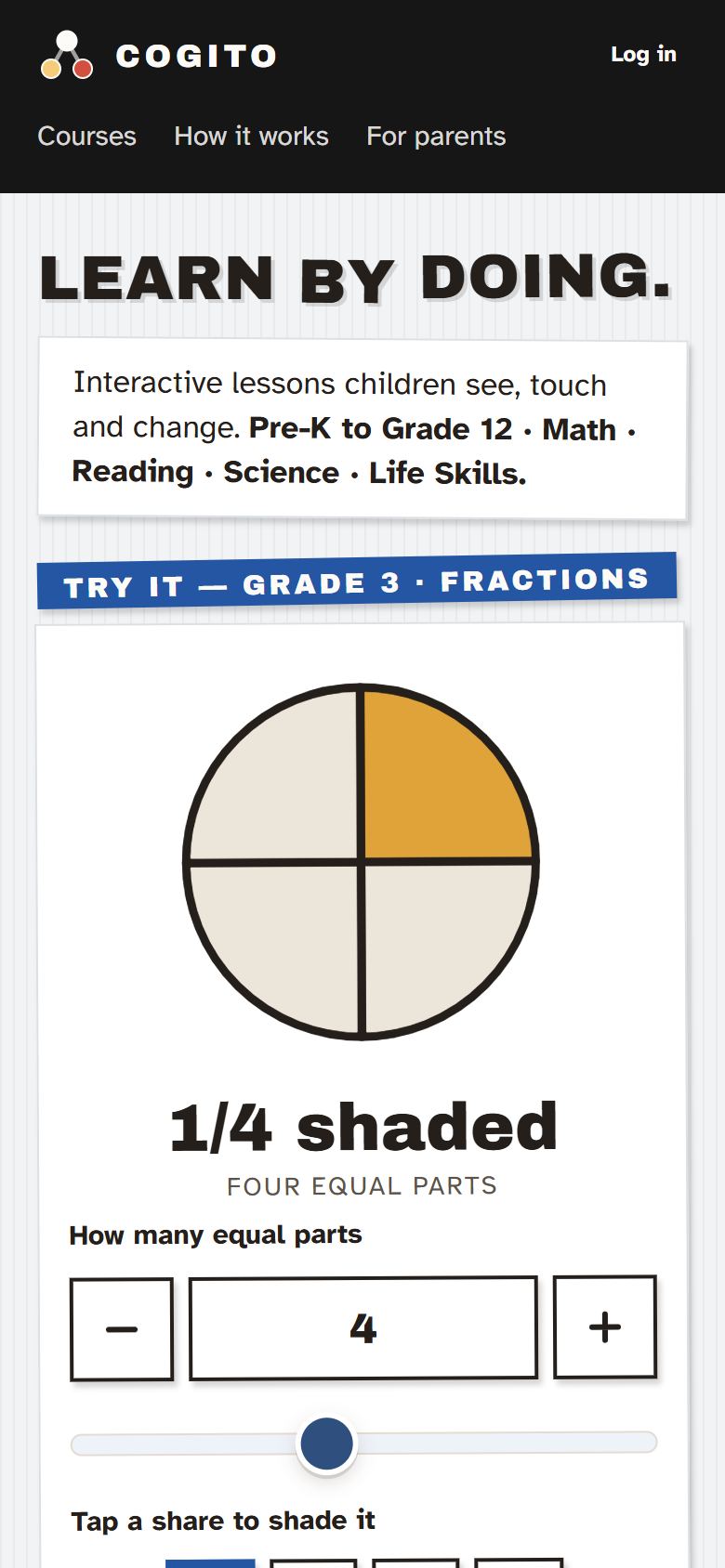
- Scroll down a little. You will see a row of lessons under These are real lessons. Go on, try them. Drag a slider and watch the picture change. That is what every lesson is like.
- Keep scrolling to the list of courses. Choose the subject at the top — Math, Science or Reading.
- Choose the stage that fits your child, then the grade, then tap a course to open it.
- Tap Chapter 1, then Lesson 1. That lesson is free and always will be.
What you will need
A phone, tablet, laptop or desktop computer, and an internet connection. Anything made in the last several years will do. There is nothing to install and nothing to download.
Is my child too young or too old?
Courses run from pre-K, which is roughly ages three to four, up to Algebra 2, Calculus and AP Physics. If your child is somewhere in the middle and you are not sure which grade to choose, the chapter on helping your child explains how to pick a starting point — and why starting slightly too easy is better than slightly too hard.