Part 17 of 25
Fun & Think
Twenty-four short things to play, and almost none of them need reading. A child who cannot read a word yet can open Fun & Think, pick something from the pictures and start — which is the whole design rule the section was built to.
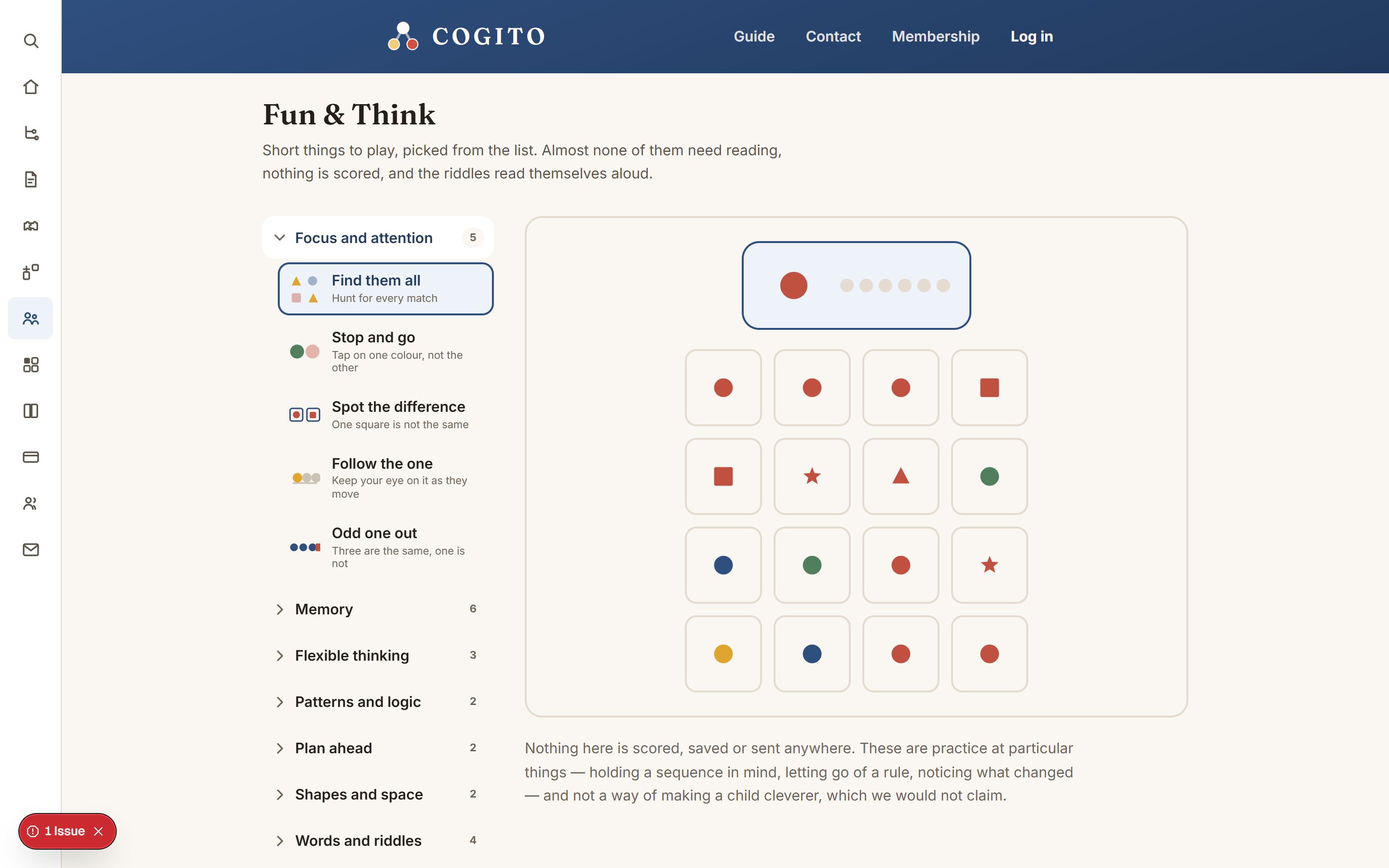
Finding your way around
- Open Fun & Think in the menu.
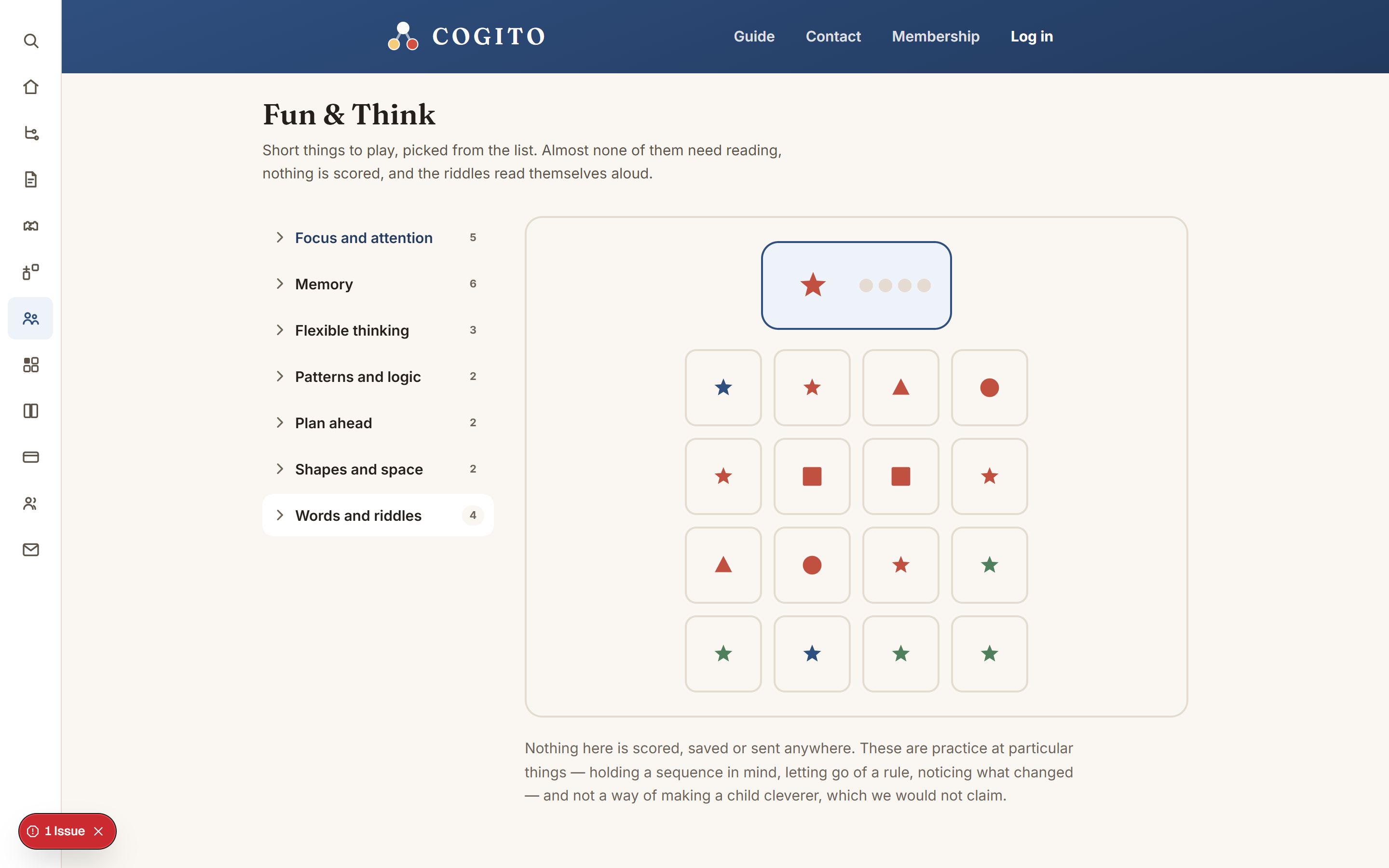
- The list down the side has seven groups. Tap one to open it; the others close, so the page never becomes a long scroll.
- On a phone the same list is a row of pictures along the top — swipe it sideways.
What is in each group
- Focus and attention — hunting for every match, tapping on one color but not the other, spotting the one square that changed, keeping your eye on a cup as they shuffle.
- Memory — copying a sequence of lights, then doing it backwards; noticing what vanished; remembering where things sat; pairs; and following spoken instructions.
- Flexible thinking — sorting under a rule that changes halfway through, which is harder and more useful than it sounds.
- Patterns and logic — working out what comes next, or what is missing from the middle.
- Plan ahead — reaching the star in exactly the moves you are given, and moving a tower without ever putting a big disc on a small one.
- Shapes and space — matching a shape that has been turned, and completing the other half of a picture.
- Words and riddles — riddles, rhymes, opposites and odd-one-out. These are the only ones made of language, and they read themselves aloud.
Nothing is scored
There are no points, no levels to lose and no streak to protect. A wrong answer never ends anything — the lights simply play again, a wrong tap costs a shake, and a riddle stays open until it clicks.
How long
Five or ten minutes is plenty, and most of them are done in two. They are a good landing place after a lesson, or for the ten minutes before dinner when nobody has the patience to start a chapter.